I've been wanting to do this for ages now, and the start of a new year seems the perfect time to do it, so hear ye, read ye: I give you one heck of a massive blog post chock full of information on exactly how I keep my correspondence records, complete with monthly and yearly statistics at the end. (Beware, this may be a frightening glimpse into my quirky depths. But isn't that why we all read blogs anyway?)
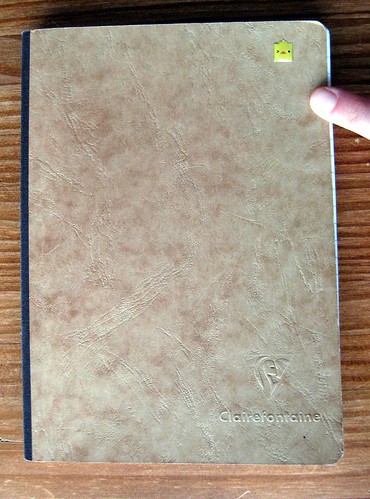
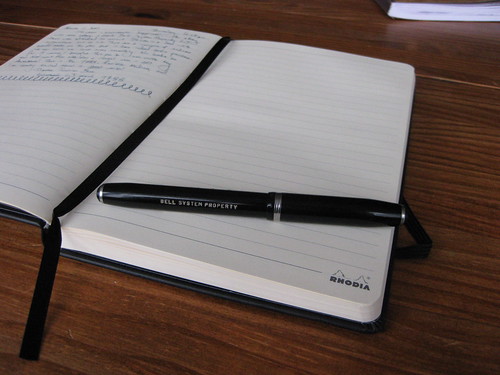
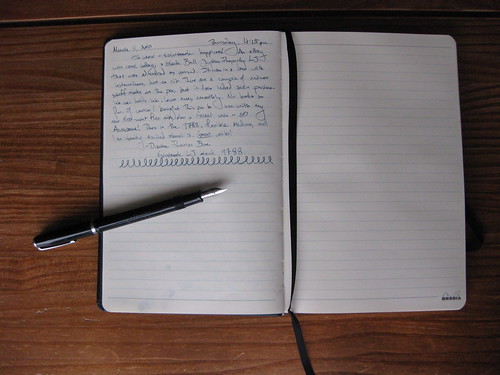
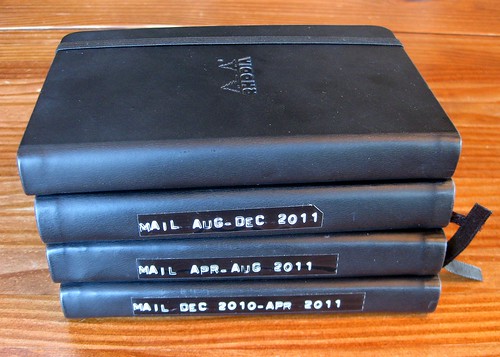
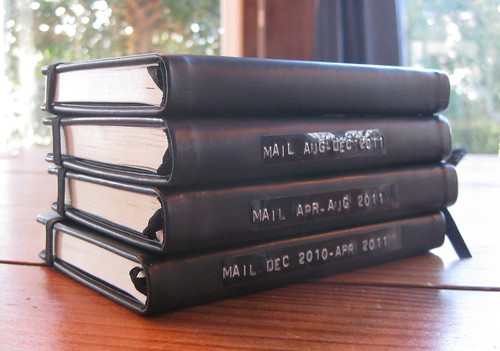
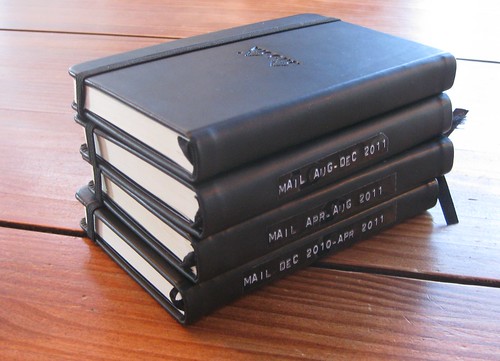
Every day I record my mail, both incoming and outgoing. I haven't settled on a good name for the books yet; I refer to them as letter journals, mail logs, correspondence records, letter logs, and mailbooks, depending on my mood. I have come to favor the small lined Rhodia Webnotebooks for this task, for a variety of reasons: they're the perfect size for my needs, the paper takes fountain pen ink beautifully, they travel well, I like the weight and color... I could go on and on. Sometimes I think about switching it up, but for now I like this habit. Also, the month/year labels just fit on them so darn nicely.
I just started a new one recently, and I average about 4 months of mail per book. (I recommend Rhodia Webnotebooks from Goulet Pens and Jetpens; they do not endorse or sponsor me in any way, I am just a very satisfied customer of both fine online retailers.)
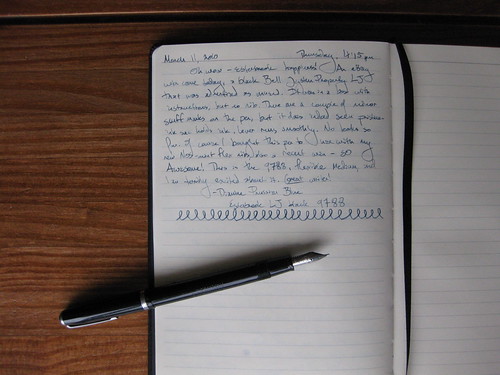
I record incoming and outgoing mail separately. For incoming, I do all the day's mail (or multiple days, if I've been away or - gasp! - so busy I can't make it to the mailbox) in one sitting, logging it as I read it. All received mail gets recorded with a Pilot Varsity disposable fountain pen, refilled with Noodler's Heart of Darkness (black, black, very black and permanent) ink. Outgoing letters get logged as they're written, using the last color ink I used for the letter.
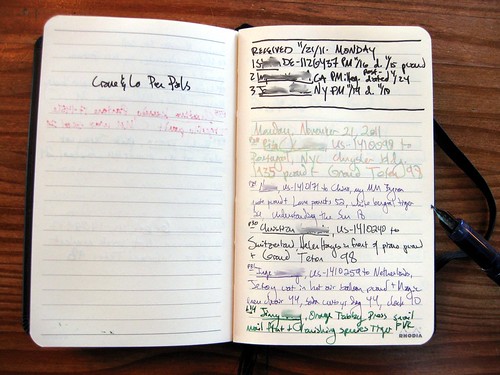
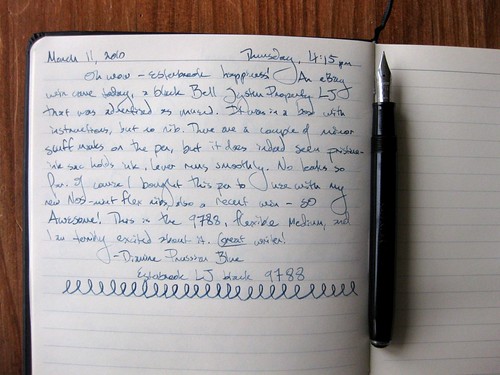
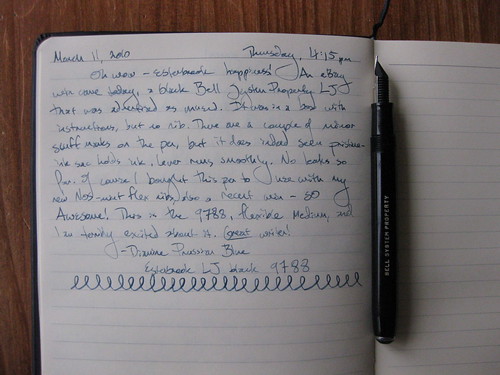
Here's a fair sample page with personal information blurred out. In the received section, I note the sender, location/US state or country (with Postcrossing ID if applicable; other notes, like swaps or misc info like background on the sender, I list on the facing page), postmark date or note illegible, item date or note undated, and postcards get listed first and noted as postcards.
A while back, I started satisfying some of my own curiosity with statistics. Nothing mathematically fancy here, just plain counting. It greatly facilitates my own tallies if I designate letters and postcards numerically by month. I did this all through 2011 for sent items by month, and it made counting the entire year's output exponentially simpler. In 2012 I shall do this for received items as well. That is what the designations before each entry, such as P29 or L14, mean. On this page, P29 is the 29th postcard and L14 is the 14th letter written in November. (One little statistical note, now that my etsy shop is a year old, too: although I write a note with every etsy order, I do not tally those in statistics or log them in my mailbook. They are not personal correspondence.)
So today I went through and counted them all manually. At times like this I wish I kept a fancier spreadsheet; it would be handy or at least interesting, for example, to find out how many things I sent domestically vs to foreign countries (that info is in my written records but I didn't tally it for this), or, perhaps more daunting, exactly how much money I spent on postage in a year. But I really enjoy the ritual of writing in a notebook filled with quality paper, using fountain pens or other fun writing instruments. It's a part of the process that I enjoy, and I would not enjoy keeping a spreadsheet nearly so much.

Enough nattering. Here are the numbers by month. Because I noted letters and postcards separately as I sent them, but not received them, they are broken out thusly as follows:
January 2011
Sent: 39 letters, 48 postcards = 87
Received: 71
February 2011
Sent: 37 letters, 39 postcards = 76
Received: 69
March 2011
Sent: 32 letters, 56 postcards = 88
Received: 74
April 2011
Sent: 39 letters, 56 postcards = 95
Received: 83
May 2011
Sent: 20 letters, 46 postcards = 66
Received: 88
June 2011
Sent: 48 letters, 104 postcards = 152
Received: 120
July 2011
Sent: 36 letters, 83 postcards = 119
Received: 126
August 2011
Sent: 32 letters, 75 postcards = 107
Received: 147
September 2011
Sent: 18 letters, 45 postcards = 63
Received: 92
October 2011
Sent: 12 letters, 50 postcards = 62
Received: 89
November 2011
Sent: 20 letters, 51 postcards = 71
Received: 53
December 2011
Sent: 44 letters, 41 postcards = 85
Received: 69
SENT TOTAL: 377 letters, 694 postcards / 1071 total
RECEIVED TOTAL: 1081
Postcrossing is also great about emailing monthly and yearly stats. I am not including those numbers in the monthly totals, because Postcrossing doesn't count a postcards as "sent" until it is registered, and it could be registered a month or even two after I sent it. But the yearly totals are fun, so I'll note that of the totals listed above, 326 of the sent items and 333 of the received items were Postcrossing postcards.
If you'll permit me some more characters (in an already lengthy post) of reflection, I have to note that I'm fairly cheered that my sent total is only slightly behind my received for the year. I am many months behind in responding to mail I've received, and I dare not even count the numbers in my current "needs response" (NR) pile, but the total of letters and postcards in that daunting NR pile always seems to hover around 100 or so, dating back for those many months. I don't stay on top of it by any means (obviously!), but I try to keep up a steady stream. And an average of nearly 3 mail items sent per day, with at least one of them a letter, is pretty respectable for me and my crazy schedule; it's what I'd hoped I'd achieved, and I'm pleased and proud that I have managed it. You can tell a lot about my schedule by the month's outgoing tallies; I'm a bit surprised, though, because I always feel the busiest in the winter months, but the lowest outgoing months were actually September, October, and May. Those are also busy months for me, and this year was especially skewed since I got very sick in October and did far less mail than usual that month.

Blah, blah, blah. Numbers are fun, but I hope I can maintain some credibility, after spouting all those figures, when I attest that the spirit of my postal journey is far more about quality than quantity. Postcards do tend to be quicker than letters, but for those items contained in an envelope, I may spend 10 minutes on one or I may spend 6 hours. At the end of the day and the end of the year, I am very happy with the year in mail for 2011. I wish I weren't so behind, but I've been behind for two years now and I doubt I'll catch up anytime soon, so I've given up worrying about that too much.
I'll also err on the side of being a little preachy and note that the months of and following my most productive send numbers were also the richest in received numbers. Here you go, folks, numerical proof: to get a letter, send a letter!
This post has become more loquacious than I ever intended, but I guess some of my favorite posts end up that way. Thanks for bearing with me. It's been a great mail year, full of postal joy and fulfillment... what about you? Was 2011 a good mail year for you, too?